Showing posts with label Bicycle History. Show all posts

Thursday, July 12, 2012

Changing of the Guard


Dear Readers,

We are having a changing of the guard (well, bloggers) here at Alpena Tweed and Bike Club. So as I sign off I would thank you for reading, and hope that you have found the blog both entertaining and informative. I am sure the new bloggers will continue this tradition, and build up a great resource for Tweed Rides all over the world.  I hope to see you on the road. P


Thursday, May 3, 2012

Kalamazoo Cycle Company


A few days ago I ran across an advertisement for a cool looking basket. After a closer inspection I noticed it was made by the Kalamazoo Cycle Company... this meant I had to find out more about this company and post it… Ironically at the very same time a group called Vanished from KalamazooCounty was posting a blurb about the Kalamazoo Cycle Company. I will let you jump over there to see a few pictures of the actual shop, and find out a little information about it, but here are a few pictures of some of the stuff they made.


Filing date: Jan 9, 1893

Tuesday, February 14, 2012

Happy Singles Appreciation Day!

With the possible exception of the kayak, no single mode of transportation is so geared to glory of the unattached as the trusty bicycle!
So ride single, ride free my friends!

Rita Hayworth c. 1940's


Happy Valentine’s Day!

Well nothing says love more than some campy,
old postcards full of puns!


 We hope you enjoy!


Friday, February 10, 2012

The New Woman and Her Bicycle

While surfing the internet for something else, I ran across this Illustration about the fears of Women’s Rights and the bicycle. The illustration was originally from a 1895 edition of Puck  magazine (artists signature appears to be Joseph Ferdinand Keppler, 1838-1894) and the main title (for those of you who can’t make it out) is THE “NEW WOMAN” AND HER BICYCLE – THERE WILL BE SEVERAL VARIETIES OF HER. The funny thing about this picture (to me) is that it is hard to tell if this is for or against THE “NEW WOMAN”


The main/middle picture is of THE “NEW WOMAN” -  Starting with the largest picture of a slightly snooty looking woman dressed in Victorian Riding Cloths, my gut reaction is that they are mocking her… but if you look at her details, she is no longer afraid of mice. Where in the picture over her right shoulder she is shown standing on a chair with one of the vial beasts begging at her feet. I don’t mean this to sound sexist, but I am curious if I need to buy my girlfriend the hat or boots to get the same affect… and if it would work with spiders too…

Starting in the upper left and continuing clock wise:

 The “new” Servant Girl: her Sunday out – I guess they are worried about the city's unattractive “New Servant Girls” swarming the street? Now I have recently watched Downton Abbey, and I can say for certain most servant girls were highly attractive, so I am not sure what they were worried about…

The “new” Mother-in-Law, arriving for a long visit – Ok, I really don’t need to explain why this is a real concern, and significant fear! I do love that this joke works so well, even after 100 years.

The “new” Salvation Army Lassies –  All I can say about these “Lasses” is that I would ask them to not play the tambourine, bass drum, or read books while riding on our Tweed Ride… and we worry about people talking on cell phones…

The “new” Widow – To quote the Legendary Tom T. Hall “Oh, some women do look good in black” (I can’t believe I could come up with a ‘hot widow, at a cemetery, in black’ reference off the top of my head!), and I think Tom would appreciate this attractive widow morning her husband!  Honestly, I guess the problem was that she “might get around”, as you say, but I was unaware that Victorian women were supposed to burn themselves on their husband’s funeral pyre.

The “new” Nurse-Girl –  I do like that this Nurse-Girl is wearing a bonnet, and not a hat, and that they now actually make little baby carts! I kind of hope that the artist got a patented for this idea.

The “new” Washerwoman – All I can say about this poor lady is that she really should talk to that Nurse-Girl. That laundry must really hurt her arm. Part of the joke that will probably be lost on modern viewers is that for a long time suspenders/braces were considered undergarments, and no classy man would show them in public. This was the plumber’s crack of the Victorian Era. So here we have an unattractive, working woman showing her plumber’s crack.


We hope you enjoyed the picture!


Friday, December 16, 2011

Bicycle Sports to Consider

[Don’t Try This At Home]
Think of all the things that you could do next spring on your bike; you have long rides like races or tours, or short fun rides like our Tweed Rides, or you could start a sweet bicycle sport.  


For example there is Bicycle Polo; think of rich dudes riding around on expensive ponies trying to hit a little ball… except switch out the pony for a bike, and you don’t need the cash flow to feed the steel steed so anyone can take part.


Started in Ireland in 1891 and even exhibited in the 1908 Olympics, this is hardly a new sport. While in its most popular incarnation today is played on hard courts instead of the traditional grass, it is still basically people riding around trying to hit a little ball.


Often played on low geared  single or fixed geared bikes by people who don’t mind taking a tumble off their ride; All you really need are some great bike handling skills, a mallet and a street hockey ball. It is reportedly pretty addictive, so you might want to think twice about starting the habit.


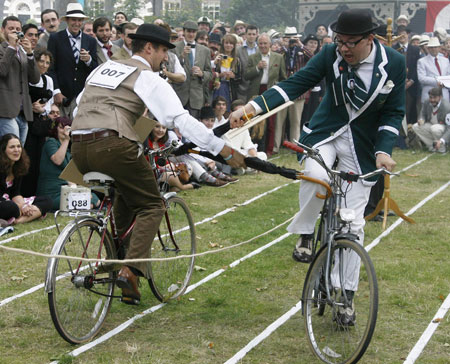
Another bike sport that you might not want to let your mom know you want to try is bicycle jousting!


Whether you participate in something like The Chap Olympiad and use umbrellas to try to pull each other off the bike or ride a Tall Bike and hit each other with lances, the general idea is to duplicate the shenanigans of Medieval Knights and put your opponent on the ground while you ride away.


Here is a starter set for your kids!

Then I ran across this photo and came up with my own idea!


Sadly after doing a quick internet search I found I was not the first to think of it, but still imagine the possibilities of BICYCLE CHARIOT RACING!


You could have straight up Ben Hur races (think of one to four “horses”) or maybe archery where the charioteer shoots at a target as they ride by, or even a modified type of jousting.  The possibilities are endless!


While we don’t recommend the average rider take up any of these sports, we do suggest thinking about other things your bike can do besides riding in a straight line.


Wednesday, November 16, 2011

Wheels of Change – Sue Macy


Wheels of Change; How Women Rode the Bicycle to Freedom (With a Few Flat Tires Along the Way) by Sue Macy is published by a little known publishing company, National Geographic  (wait, maybe I’ve heard of it a time or two). While most of the readers of this blog probably haven’t  had the opportunity to take a 400 level class on Women in America Since 1870 taught by a PhD specializing in women’s sports history, if they have really followed this blog over the last year they will have already come across most of the revelations in this book. Now saying that, this would be a great book for anyone who is interested in bicycle history! Written mainly for the pre-teen and high school audience, the pictures and style should appeal to everyone even if it's just a refresher.  

 Denver, Colorado, circa 1905

We see old friends like Bloomer, Kopchovsky and Pope (that’s Albert Pope not “The Pope”) Macy covers both the early evolution of the bike, and the Woman’s Rights Movement. This bike also introduces us to many other great members of cycling past. There are great photos of rare bikes like a sidesaddle Penny-Farthing and African American cyclists of the time. This book also gathers together many great quotes. Including my favorite from Charlotte Smith (Brooklyn Eagle, August 20, 1896) “Many a girl has come to her ruin through a spin on a country road”; everyone in rural Northern Michigan knows all about the evil of a country road! And who can blame her or those of a similar mind for worrying about women once they started dressing like men! Oh my! Though I bet those souls are once again rolling over in their graves with the current bicycle chic movement.

 Lady on the right has a sidesaddle bike

Anyway! This is a great book that links the importance of the bicycle to what we consider the modern role of women in our society. It may soft peddle (pun intended) the role of the bicycle in general society, but that is not a detractor for what it offers. We strongly recommend this book.

Wednesday, October 12, 2011

Bicycles in the News

Here is a cool article we ran across from the Detroit News, in part about bicycles in Michigan.


A bicycle built for 10 from 1896. This tandem bike is part of the collection at the Henry Ford Museum at Greenfield Village.

How the bicycle put Detroit on wheels
By Vivian M. Baulch / The Detroit News

http://apps.detnews.com/apps/history/index.php?id=21

"This fast crowd of cyclists were the first Detroiters to complain about bumpy potholed dirt roads and began lobbying for smooth paving. Historians attribute the automobile's explosion of growth in Detroit to the network of superior roads built for bicyclists."


Bicycle enthusiast Harry Shaw of Saginaw rides his new bike in 1880.

Friday, September 30, 2011

Ride to Freedom – Yesterday and Today

We have already written a few posts about how bicycles help increase mobility for western women in the late 19th and early 20th century, but the bicycles impact on mobility is much more substantial. Not to minimize the importance of the steel steed on the fairer-sex, but the fact is that it increased the mobility of many people in that time. Originally personal transportation choice was horse or horse and cart, and then as times changed options increased with the car, truck, and motorcycle.  The author, as someone who has owned all four of these options, can vouch for the fact that none of these are cheap to keep in running shape and all take an experienced hand and specialized tools to maintain.


Here lies the beauty of the bicycle in its many forms.  After its initial purchase, little money is required in its maintenance. Note I said required, not desired; upgrades for performance are completely different from feeding a horse, or filling up a car. We all know people (or are ‘them’ ourselves) who have had bicycles for years and do little more than ‘push the pedals’ and still ride them for years. Still for those who do desire to work on, or repair their bikes, the tools for most jobs are very basic. Lastly bicycles take up relatively little space to store. A great feature if you live in large cities, and small living spaces.


Roy Rogers on a Bike talking to Trigger


This has made the bicycle the primary mode of transportation for the poor, frugal, young and many others since its inception.  Advertisers and society have often linked it to young love in song, think Daisy Bell (aka Bicycle Built for Two), and photos. With the exception of bikes sold to athletes, the people in ads either are children or a couple in some stage of courtship. Even though the majority of the West seems to be happy to leave the bike in this realm, I am sure we have all viewed pictures of people in Asia and Africa carrying large loads of goods and people on their bike.  The simplicity of the bicycle still fits the role of primary transportation around the world.


Rover Ad, c. 1896 (later day makers of the Land Rover)
Man trying to pick up the ladies.

Schwinn Ad from the 1970's
Still a man picking up a lady... but who rides a road bike into the pool?


So much so that many worthwhile groups are working hard on placing bicycles in the hands of the poor and disadvantaged in both the United States and around the world. Groups like Bikes for the World, The Bamboo Bike Project, and Bikes for Africa use different methods of collecting, building and distributing bikes to people, but all are trying to increase the mobility of people everywhere.  Without getting into specifics about any individual program (Note: we are not affiliated with any of these groups) each shares the story about how the difference between getting food to the market, children to school, water into a home or doing without one of these basic necessities is often the availability of reliable transportation. This is not an attempt to beg money for any of these groups. Just an illustration of how it is important to view the bicycle as the life changing tool, not a toy or some sort of sporting good. Viva la  bicycle!