Sunday, June 19, 2011

Children’s Fashion

We have previously blogged on men's fashion and accessories as well as the female counterpart. But what about the kids? We are encouraging EVERYONE to dress in turn of the century style! Initially children wore smaller versions of adult clothing, but as the turn of the century neared, their clothing began to change.
Sailor Suit
Boys 1890 - 1930
  
 Small boys wore romper combination overalls and until they were around 5 years old. It was not unknown for boys of the same age to also wear little tunics that looked like dresses. There was an evolution of dress through a boy’s life: as a young boy he would wear a knickerbocker suit (or short trousers), then progressed to full suit (or long trousers). By the 1930s the change from short to long trousers was seen as a sign of manhood and was eagerly awaited by boys. One of the most popular looks (matching men of the era) was the Norfolk suit, with its high-buttoning jacket and integral belt. This was the standard daily wear for many well-dressed British boys as well as some American boys. Other suits for more affluent boys took their names from private schools like Rugby and Eton. The sailor suit was a popular choice until around 1920 when it was replaced with low waist tunics and shorts. Another popular look from 1916 to the 1940s was the 'Buster Brown suit' . This suit was a short smock-like suit, showing bloomer pants worn above the knee with long over the knee stockings. Most Buster Brown suits were worn with a broad white collar and large floppy bow sailor hat. These suits were worn by boys from about 5 to 8 years of age, but some mother’s dressed older boys in them for a few additional years.  The traditional combination (vest and long johns) were worn underneath most suit coats, but they were replaced by short sleeved vests and pants around 1926. Caps and jackets remained popular and knitted jerseys became so, especially after the Great War.
  
Norfolk Suit: These clearly upper-class boys are brothers and are being photographed in the family garden. The older boy, wearing a Norfolk suit with knee trousers, long black stockings, and a flat cap is about twelve or thirteen. His little brother (about five or six) wears a white tunic suit with a fancy lace collar, a straw hat, white socks, and strap shoes  


Pinafore
 Girls 1890 - 1930


Though earlier girl's undergarments were cumbersome, by the 1890’s separates (skirts and blouses) had become fashionable. Much like boy’s fashion, the sailor suits was also popular for girls as school or holiday wear from the 1890s until the 1920s.

Gymslip
Yet dresses were still popular, In 1908 the liberty bodices, in knitted cotton fabrics, began to replace the tortuous corsets.  Around 1910, the yoked dresses, with their high, modestly fitted waist and smock shape, came into vogue. The classic Pinafore was introduced in 1912, followed by the school gymslip in the 1920s. Following women’s fashions the waist dropped to hip level In 1919 and in by 1925 skirts and knickers rose to knee length. At the same time liberty bodices and vests were became sleeveless.  The 1930’s saw the rise of the 'Shirley Temple look' of longer skirts, frills and flounces.
Shirley Temple


Thursday, June 16, 2011

Wheels of Change

Bikes have done more than provide fun transportation!

The 1890s was the peak of the first American bicycle craze and consumers were buying bicycles in large numbers. In 1897 alone, more than two million bicycles were sold in the United States, about one for every 30 inhabitants. What you may not know, however, is that the woman’s rights movement had some major growth with the bicycle! If fact, one-third of all those in the market for a bike were female. These women would prove to play an integral role in the struggle for women's rights.


Susan B. Anthony, who dedicated her life to the women’s suffrage movement, is noted for saying, “Let me tell you what I think of bicycling…I think it has done more to emancipate women than anything else in the world. I stand and rejoice every time I see a woman ride on a wheel. It gives women a feeling of freedom and self-reliance".


from http://www.annielondonderry.com 

For women, the initial struggle was for the right to ride a bicycle at all; this debate lasted until the early 1890s. From the beginning, there were a significant number of people who firmly believed that machinery and athletic activity should remain part of a man’s world and that a woman’s world should remain distinct and separate. Questions surrounding the issue of women on bicycles arose, such as: how women should ride, when they should ride, who they should ride with, what clothing they should ride in and whether they should race. Many critics were convinced that bicycle riding threatened women’s physical and mental health; their hair, complexions, femininity, families, morals and worst of all, their reputations!!


As cycling’s popularity exploded, a new breed of woman was making her mark in the 1890s. “The New Woman” was the term used to describe the modern woman who broke with convention by working outside the home, or eschewed the traditional role of wife and mother, or became politically active in the woman’s suffrage movement or other social issues. The New Woman saw herself as the equal of men and the bicycle helped her assert herself as such!!


Elizabeth Cady Stanton, a leader in the women’s movement wrote in an 1895 article for the American Wheelman, that “the bicycle will inspire women with more courage, self-respect, self-reliance….” It was a prophetic statement as women, who were leaving their homes (unchaperoned!) to socialize and cycle on country roads and in parks and becoming more involved in public life. Young women were gaining more freedoms and with that came confidence and a feeling of empowerment as the Victorian era drew to a close.


As women learned to ride bicycles they not only gained physical mobility that broadened their horizons beyond the neighborhoods in which they lived, they discovered a new-found sense of freedom of movement, that the cumbersome fashions of the Victorian era could not provide, as well as by Victorian sensibilities. The restrictive clothing of the era -- corsets, long, heavy, multi-layered skirts worn over petticoats or hoop, and long sleeved shirts with high collars -- inhibited freedom of movement. Such clothing inhibited even modest forms of exercise or exertion. Cycling required a more practical form of dress, and large billowing skirts and corsets started to give way to bloomers (see previous blog). Although bloomers first appeared decades earlier, and a major social battle was waged over their propriety, the cycling craze practically mandated changes in women’s attire for any woman who wanted to ride.

Friday, June 10, 2011

Why Ride?

Everyone looks cool on a bicycle!

  Elvis Presley in Germany (1959)

Thursday, June 9, 2011

Old Magazine Articles

Cool website with pdf's of Old Magazine Articles (hence the name). Check out the fashion sections.

Women’s Accessories

1910-1919
This is the era of big hats, sometimes very plain, some with great masses of feathers and flowers. 

Towards the end of the decade hats slowly shrank and brims became firm. Because of the Orientalism movement, some women even wore turbans. Hair was also big, with the popular idea being pushed through the previous few decades by Charles Dana Gibson and his Gibson Girls. Even though “Bobbed Hair” is typically thought of as belonging to the next decade, it did make its appearance in this decade as can be viewed in the following 1912 Ziegfeld Follies poster.


Fur stoles and muffs were in vogue as were pearls and simple pendants in the Art Nouveau or Oriental style. Belts and sashes were large and often worn high at the beginning of the decade and slowly moved down to the natural waist by its end. The goal was to accent (or imply) a long, lank frame.

1920-1929
 Louise Brooks

The quintessential hat of the twenties was the cloche, popularized by actresses like Clara Bow (the “It Girl”) and Louise Brooks. While other hats were worn, most were of a close fitting variety or caps that accented the now popular Bobbed hair. Jewelry such as bracelets and brooches became flashier, pearls were still popular and necklaces seem to plunge down to the waistline while hemlines seemed to be retreating to the same point.  The last flapper essential was the little clasp purse.

Wednesday, June 8, 2011

Women’s Fashion

Well I honestly feel we shorted you ladies with the last style post, so this is an attempt to give a better overview. In Bloomers and Women's Fashion we made the argument for the right of women to wear PLO’s (Pant like Objects) in the sporting realm. Today is fashion trends in general.

1900-1919
1911

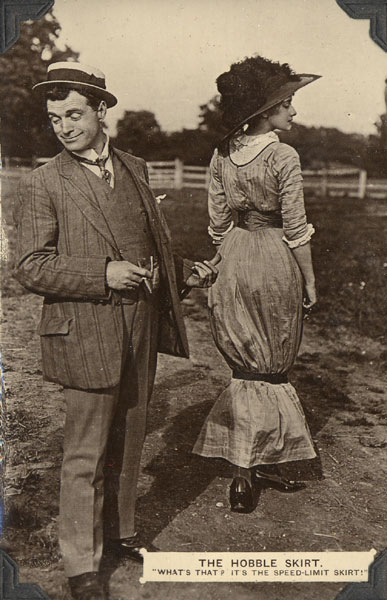
This is the era of Orientalism and the Art Nouveau (New Art) movement. It is important to remember that Orientalism did not only look to the Far East (Japan and China) but also into the Middle East (Egypt in particular). These movements idealized a long, thin, fluid, and almost cat like quality for the fashionable woman.  The archetypal look seems to be a long skirt (sometimes a long underskirt and a shorter over skirt) paired with a long tunic. Early in the era you see belted high waist lines that are reminiscent of an empire waist or maybe the Japanese Kimono.


This waist line dropped over the decade ending near the natural waistline. At the same time the hemline started to rise. The tunics seem to lengthen, everything seems to fill out a little and the waistline is less defined. 

World War I greatly changed the look of women’s fashion. Whether it was from cloth and money being diverted to the war effort or the fact that women were asked to take a more active life, but fashion started to stress function. Hemlines rose, suits were tailored, outfits simplified, and colors muted.


1920-1929


Oh, the roaring twenties!  While many women kept the practicality of the WWI suit, and sensible shoes, the classic image is that of the flapper. Though the true flapper was probably quite rare, there was defiantly a divide between mature women and that of the youth culture. Long gone were the days of the high waist that rode just below the breast, the new trend was to go for a flat chested boyish look.


Hemlines shorted even more and were often pleated to allow for a sportier lifestyle.  Blouses and dresses were cut very straight to ascent this “boyish” look. This is also the era were the sporty sweater/skirt outfit became popular at the tennis courts and other outdoor events. The only part that flowed was the hemline around the now visible knees!